
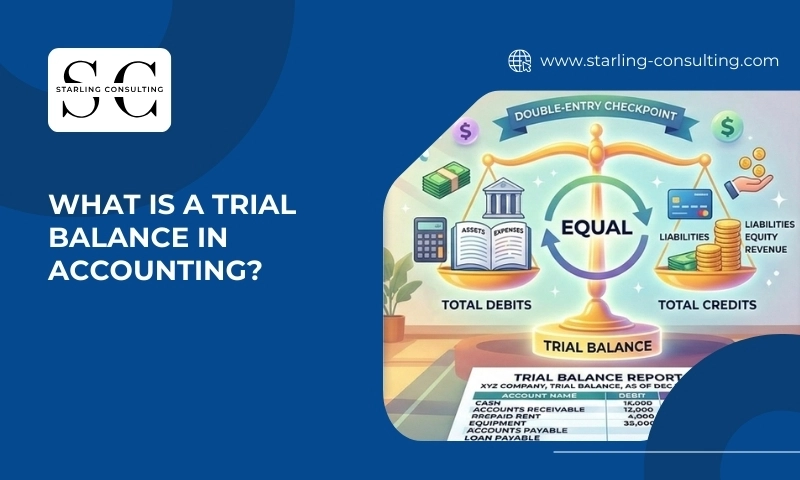
A trial balance is an internal financial report that lists the closing balances of all ledger accounts in a company at a specific point in time. The primary goal is to confirm that the total of all debit balances equals the total of all credit balances, verifying that the double-entry bookkeeping system is mathematically in balance.
The trial balance acts as a checkpoint before preparing the final financial statements, such as the income statement and balance sheet. It is not a financial statement in itself, but rather a working document used by accountants to detect errors and ensure the books are accurate.
Trial Balance Format
The standard trial balance format is a two-column report. The left column records debit balances, and the right column records credit balances. Every general ledger account is listed, along with its ending balance, placed in the appropriate column.
| Account Name | Account Type | Debit ($) | Credit ($) |
| Cash | Asset | 25,000 | |
| Accounts Receivable | Asset | 12,500 | |
| Inventory | Asset | 8,000 | |
| Equipment | Asset | 40,000 | |
| Accounts Payable | Liability | 9,500 | |
| Notes Payable | Liability | 20,000 | |
| Owner’s Equity | Equity | 30,000 | |
| Revenue | Revenue | 55,000 | |
| Salaries Expense | Expense | 18,000 | |
| Rent Expense | Expense | 6,000 | |
| Utilities Expense | Expense | 2,000 | |
| Advertising Expense | Expense | 3,000 | |
| TOTAL | 114,500 | 114,500 |
In the example above, total debits ($114,500) equal total credits ($114,500), confirming the books are in balance. This is a simplified trial balance example in real businesses; there may be dozens or hundreds of accounts.
How to Prepare a Trial Balance
Preparing a trial balance is a straightforward process that follows the natural flow of the accounting cycle. Here is a step-by-step breakdown:
1. Record all transactions in the general journal.
Every financial transaction must be recorded as a journal entry using the double-entry system — each entry has at least one debit and one credit.
2. Post transactions to the general ledger.
Journal entries are then posted to individual ledger accounts (e.g., Cash, Accounts Payable, Revenue).
3. Calculate the ending balance for each account.
Sum all debits and credits for each account to determine its closing balance.
4. List all accounts in the trial balance.
Arrange accounts in the standard order: assets, liabilities, equity, revenues, and expenses.
5. Total the debit and credit columns.
Add up each column. If they are equal, your trial balance is correct. If not, you need to trace back through your entries to find the error.
The Difference Between the Unadjusted and the Adjusted Trial Balance
One of the most common questions accountants face is: What exactly is the difference between the unadjusted and adjusted trial balance? Both serve important roles in the accounting cycle, but they come at different stages.
Unadjusted Trial Balance
The unadjusted trial balance is prepared before any end-of-period adjusting entries are made. It simply reflects the raw ledger balances as they stand after recording all regular transactions during the accounting period. It is essentially a first draft useful for spotting obvious errors, but not yet ready for financial statement preparation.
Adjusted Trial Balance
The adjusted trial balance is prepared after all adjusting entries have been recorded and posted. Adjusting entries account for items such as accrued revenues, accrued expenses, prepaid expenses, depreciation, and unearned revenue. These entries ensure that all revenues and expenses are recorded in the correct accounting period, in accordance with the accrual basis of accounting.
| Feature | Unadjusted Trial Balance | Adjusted trial balance |
| Timing | Before adjusting entries | After adjusting entries |
| Accuracy | Preliminary/raw data | More accurate & complete |
| purpose | Detect basic errors | Prepare financial statements |
| Includes Accruals? | No | Yes |
| Includes Depreciation? | No | Yes |
What Is the Purpose of Preparing an Adjusted Trial Balance?
The adjusted trial balance serves as the foundation for preparing the official financial statements. Its primary purposes include:
- Ensuring all revenues and expenses are recognized in the correct period (matching principle).
- Providing an accurate, complete list of all account balances after adjustments.
- Simplifying the preparation of the income statement, statement of retained earnings, and balance sheet.
- Confirming that the books remain in balance after adjustments are posted.
Without the adjusted trial balance, financial statements would not accurately represent a company’s financial performance and position, potentially misleading investors, creditors, and other stakeholders.
The Adjusted Trial Balance Shows…
The adjusted trial balance shows the final, corrected balances of all general ledger accounts at the end of an accounting period. It reflects the impact of all adjusting entries, including:
- Depreciation of fixed assets
- Accrued salaries and wages not yet paid
- Revenues earned but not yet billed (accrued revenues)
- Prepaid expenses that have been consumed
- Unearned revenue that has now been earned
The Adjusted Trial Balance Is Prepared…
The adjusted trial balance is prepared at the end of the accounting period, after all regular transactions have been journalized and posted, and after all adjusting entries have been recorded. It comes after the unadjusted trial balance and before the preparation of formal financial statements. In the standard accounting cycle, it is typically the 7th step out of 9.
Post-Closing Trial Balance
After the financial statements have been prepared, the final step in the accounting cycle is closing the books. This involves making closing entries that transfer the balances of temporary accounts (revenues, expenses, and dividends) into the retained earnings account.
The post-closing trial balance is prepared after these closing entries have been posted. Its purpose is to verify that only permanent accounts (assets, liabilities, and equity) carry a balance into the next accounting period, and that the books are still in balance after closing.
Post-Closing Trial Balance Example
| Account Name | Account type | Debit ($) | Credit ($) |
| Cas | Asset | 25,000 | |
| Accounts Receivable | Asset | 12,500 | |
| Inventory | Asset | 8,000 | |
| Equipment | Asset | 40,000 | |
| Accumulated Depreciation | Contra Asset | 4,000 | |
| Accounts Payable | Liability | 9,500 | |
| Notes Payable | Liability | 20,000 | |
| Retained Earnings | Equity | 52,000 | |
| TOTAL | 85,500 | 85,500 |
Revenue and expense accounts (temporary accounts) have zero balances and do not appear in the post-closing trial balance. Only balance sheet accounts remain.
Trial Balance vs Balance Sheet
People often confuse the trial balance with the balance sheet because both involve a list of account balances. However, they are very different documents with distinct purposes.
| Feature | Trial Balance | Balance Sheet |
| purpose | Internal error-checking tool | External financial statement |
| Audience | Accountants / Internal team | Investors, creditors, management |
| Includes All Accounts? | Yes (all ledger accounts) | Only assets, liabilities, and equity |
| Required by GAAP\IFRS? | No | Yes |
| Format | Two-Column debit\credit list | Structured financial statement |
| Temporary Accounts? | Yes (revenues & expenses) | No |
The balance sheet is derived from the adjusted trial balance, but it presents only the permanent account balances in a structured format used by external stakeholders.
Trial Balance vs General Ledger
Another common source of confusion is the difference between the trial balance and the general ledger. These two tools are closely related but serve different functions.
What Is the General Ledger?
The general ledger is the master record of all financial transactions organized by account. It shows every individual transaction that has been recorded in each account, along with running balances. Think of it as the complete, detailed history of every accounting entry ever made.
How They Differ
| Feature | General Ledger | Trial Balance |
| Level of Detail | Every individual transaction | Just the ending balance per account |
| Purpose | Detailed record keeping | Error Detection & Summary |
| Frequency | Updated continuously | Prepared at period-end |
| Format | T-accounts or a detailed ledger | Two-Column Summary report |
| Used for | Tracing specific transactions | Confirming books are balanced |
Trial Balance Report: When and Why It Matters
A trial balance report is typically generated at the end of every accounting period — monthly, quarterly, or annually. Most modern accounting software (QuickBooks, Xero, Sage, FreshBooks) can automatically generate this report at any time.
The trial balance report is primarily used for:
- Identifying mathematical errors in journal entries and postings.
- Providing a snapshot of all account balances for review.
- Serving as the starting point for preparing financial statements.
- Helping auditors verify the accuracy of a company’s books.
The Three Types of Trial Balance at a Glance
| Type | When Prepared | Key Characteristic |
| Unadjusted Trial Balance | After recording regular transactions | Before adjusting entries, preliminary draft |
| Adjusted Trial Balance | After recording adjusting entries | Includes accruals, deferrals, and depreciation |
| Post-Closing Trial Balance | After closing entries | Includes only permanent accounts; zero temp balances |
Common Errors a Trial Balance Can and Cannot Detect
Errors the Trial Balance CAN Detect
- Mathematical errors in individual ledger accounts.
- Transposition errors (e.g., recording $540 instead of $450).
- Posting only one side of a journal entry.
- Incorrect column totals.
Errors the Trial Balance CANNOT Detect
- A transaction that was never recorded at all (omission error).
- An entry recorded in the wrong account, but with correct debit/credit amounts.
- Compensating errors that cancel each other out.
- Incorrect classification of an account (e.g., recording an asset as an expense).
Conclusion
The trial balance is an essential pillar of the accounting cycle. Whether you are preparing the unadjusted trial balance to do an initial check, building the adjusted trial balance to ensure all period-end entries are captured, or reviewing the post-closing trial balance before the next cycle begins, each version plays a vital role in maintaining accurate financial records.
Understanding the difference between the trial balance and the balance sheet, as well as how it relates to the general ledger, gives you a clearer picture of how the entire accounting system works together. The trial balance report is not just a formality, but also for accuracy.