
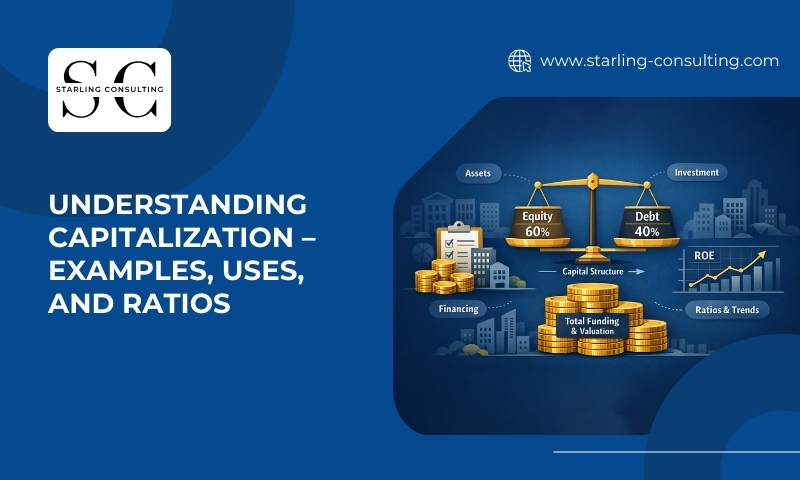
Capitalization is a key concept in business, finance, and accounting that refers to the total value of a company’s long-term funding. Simply put, it shows how a business finances its operations and growth. In accounting, it also describes how assets are recorded and valued, while in real estate, it helps assess investment potential.
Understanding capitalization is crucial because it impacts financial planning, investment decisions, and accurate reporting. For businesses, it affects how costs appear on financial statements, influencing profitability and taxes. In finance and real estate, it provides investors with insights into potential returns and associated risks. Its broad applications make it an essential concept for investors, accountants, and business owners.
What is Capitalization?
Capitalization is the process of allocating resources or costs to reflect their long-term value. In finance and accounting, it means recording money or assets that will provide benefits over time, not just immediate expenses. Unlike the everyday use of the term, it carries significant financial implications.
In business, capitalization helps track expenditures that create long-term value as assets rather than expenses. Investors use it to understand a company’s financial structure, while accountants rely on it for accurate reporting and compliance with GAAP and IFRS. It guides decisions on growth, investments, and risk management.
Capitalization Example
A startup spends $30,000 on developing software. Instead of treating it as an immediate expense, the company capitalizes the cost, recognizing it as an asset that will generate future revenue.
Practical scenarios include:
- A small business purchasing equipment or vehicles.
- An investor acquiring real estate or long-term assets.
- A company is funding a long-term project that will provide returns over several years.
Capitalization, therefore, ensures that the financial impact of long-term investments is accurately reflected over time.
Capitalization in Real Estate
In real estate, capitalization often refers to the capitalization rate, commonly called the Cap Rate. The Cap Rate is a metric used to estimate the return on an investment property based on its income-generating potential.
The formula for Cap Rate is:
Cap Rate=Net Operating Income (NOI)\Property Value×100
Example:
If a rental property generates $50,000 in net operating income and is valued at $500,000, the Cap Rate would be:
50,000\500,000 ×100=10%
This means the property yields a 10% return on its value, helping investors compare opportunities and make informed decisions. Capitalization in real estate is a critical tool for evaluating risk, expected returns, and property value.
What is Capitalization in Finance and Accounting?
In finance and accounting, capitalization involves recording a cost as an asset rather than an immediate expense. This distinction is important because it affects the financial statements and the apparent profitability of a business.
Key differences:
- Capitalizing an expenditure: Records it as a long-term asset, spreading the cost over time.
- Expensing immediately: Records it as a current expense, reducing profit in the period incurred.
Example:
If a company builds a new warehouse costing $200,000:
- Capitalizing: $200,000 is recorded as an asset and depreciated over 20 years ($10,000 per year).
- Expensing: $200,000 reduces profit entirely in the year of construction.
Capitalization impacts:
- Financial statements: Show a more stable and accurate profit over time.
- Business valuation: Proper capitalization reflects true asset value, aiding investors and lenders in assessing company worth.
Capitalization in Business
For businesses, capitalization is not just an accounting practice—it’s a strategy for growth, tax planning, and financial clarity.
Businesses capitalize:
- Startup costs: Initial expenses that will benefit the company over multiple years.
- Long-term investments: Equipment, software, or facilities.
- Intangible assets: Patents, trademarks, or proprietary software.
Benefits include:
- Accurate financial reporting.
- Reduced the immediate tax burden.
- Better insights for decision-making and investment planning.
By capitalizing the right expenditures, businesses ensure that their long-term investments are properly reflected in their balance sheets and income statements.
Capitalization Ratios
Capitalization ratios are financial metrics used to assess a company’s long-term financial stability and leverage. Key ratios include:
- Debt-to-Capital Ratio: Measures the proportion of debt in a company’s total capital.
Debt-to-Capital=Total Debt \ Debt + Equity
- Equity-to-Capital Ratio: Indicates the proportion of equity financing.
Equity-to-Capital=Shareholders’ Equity \ Total Capital
- Debt Ratio: Shows the percentage of total assets financed by debt.
Debt Ratio = Total Debt\Total Assets
Example:
If a company has $400,000 in debt and $600,000 in equity, total capital is $1,000,000:
- Debt-to-Capital = 400,000 ÷ 1,000,000 = 40%
- Equity-to-Capital = 600,000 ÷ 1,000,000 = 60%
Investors use these ratios to evaluate risk and understand a company’s funding structure. A balanced capital structure often signals financial stability, while high debt may indicate higher risk.
Capitalization under GAAP & IFRS
Capitalization rules can vary under GAAP (Generally Accepted Accounting Principles) and IFRS (International Financial Reporting Standards), but the goal is the same: recognize expenditures that provide future economic benefits as assets. GAAP tends to offer more specific guidance, while IFRS relies on broader principles and professional judgment.
Commonly capitalized assets include property, plant, equipment, and software development costs. For example, building a new factory or developing a proprietary software program can be capitalized rather than expensed immediately. Businesses must also follow compliance considerations, such as properly documenting costs, estimating useful life accurately, and ensuring alignment with the relevant accounting framework.
What is the Capitalization of Assets?
Asset capitalization is the process of recording a purchase or expenditure as a long-term asset instead of an immediate expense. This ensures that the cost is allocated over the period during which the asset generates value, giving a more accurate picture of a company’s finances.
Capital assets include machinery, buildings, and intangible assets like patents or software. Operating expenses, such as routine maintenance or office supplies, are recorded immediately and not capitalized. Correctly distinguishing between capital assets and operating expenses is crucial for accurate financial reporting and assessing business performance.
Best Practices for Capitalization
- Clearly define which expenditures qualify as capital assets.
- Track the useful life of each capitalized asset accurately.
- Record depreciation or amortization consistently over the asset’s useful life.
- Avoid common mistakes like overcapitalization or misclassifying routine expenses as assets.
- Use accounting software and asset management tools to maintain accurate records.
- Establish clear internal guidelines for capitalization policies.
- Conduct regular audits and reviews to ensure compliance with GAAP or IFRS and financial statement accuracy.
Bottom line
Capitalization is a versatile concept that plays a crucial role in finance, accounting, real estate, and business strategy. Whether you’re evaluating property, managing assets, or analyzing a company’s financial health, understanding capitalization ensures accurate reporting, smarter investment decisions, and better business planning.
By applying capitalization correctly, businesses can optimize tax benefits, maintain compliance with accounting standards, and present a clear picture of their financial performance. For investors, a solid grasp of capitalization helps assess risk, value assets accurately, and make informed long-term decisions.
FAQs
Q1. What is the difference between capitalization and capitalization rate?
Ans: Capitalization refers to the accounting or financial concept, while Cap Rate is specifically used in real estate valuation.
Q2. Can small businesses benefit from capitalization?
Ans: Yes, capitalizing expenses properly helps small businesses manage taxes, improve financial statements, and plan investments.
Q3. Does capitalization affect taxes?
Ans: Yes, capitalizing an expense spreads the cost over time, which can reduce immediate taxable income.
Q4. Are all assets capitalized in accounting?
Ans: No, only assets expected to provide future economic benefits are capitalized.
Q5. How does depreciation relate to capitalization?
Ans: Capitalized assets are depreciated over their useful life instead of being expensed immediately.
Q6. Is capitalization mandatory under GAAP or IFRS?
Ans: Yes, businesses must follow capitalization rules to comply with accounting standards.
Q7. How can investors use capitalization ratios?
Ans: Investors analyze capitalization ratios to understand a company’s financial structure, leverage, and risk profile.